Leverage astrophysical information about galaxies to learn their dynamics
Galaxies align with each other locally due to their neighbors exerting tidal forces. Using direct measurements of this effect, we can estimate its impact on cosmological surveys.McCullough, Siegel, Amon, et al. 2026
Abstract
The intrinsic alignment of galaxies remains a dominant systematic limiting the cosmological precision for weak gravitational lensing. While direct measurements of intrinsic alignments have expanded rapidly across diverse galaxy populations, cosmological analyses have typically adopted broad, survey-wide priors that do not reflect the physical properties of the galaxies being analyzed. We propose an empirical approach that leverages these direct measurements to tailor the prior on alignment to the demographics of the galaxies observed on alignment-essential axes (e.g., stellar mass and specific star-formation rate). Our method is conservative, adopting a flat prior where there are gaps in direct measurements, and agnostic to the underlying intrinsic-alignment model – naturally accommodating future measurements and model developments as the observational library expands. We demonstrate the framework using existing direct measurements fit to the nonlinear alignment model to calibrate selections of galaxies in the Dark Energy Survey COSMOS deep field. We also showcase its simple integration with existing photometric redshift calibration infrastructure, thereby enabling the joint inference of redshift distributions and intrinsic alignment priors in future surveys. Beyond informing priors, this method enables a direct route for constructing and optimizing source samples with well-understood intrinsic alignment properties for weak-lensing surveys. 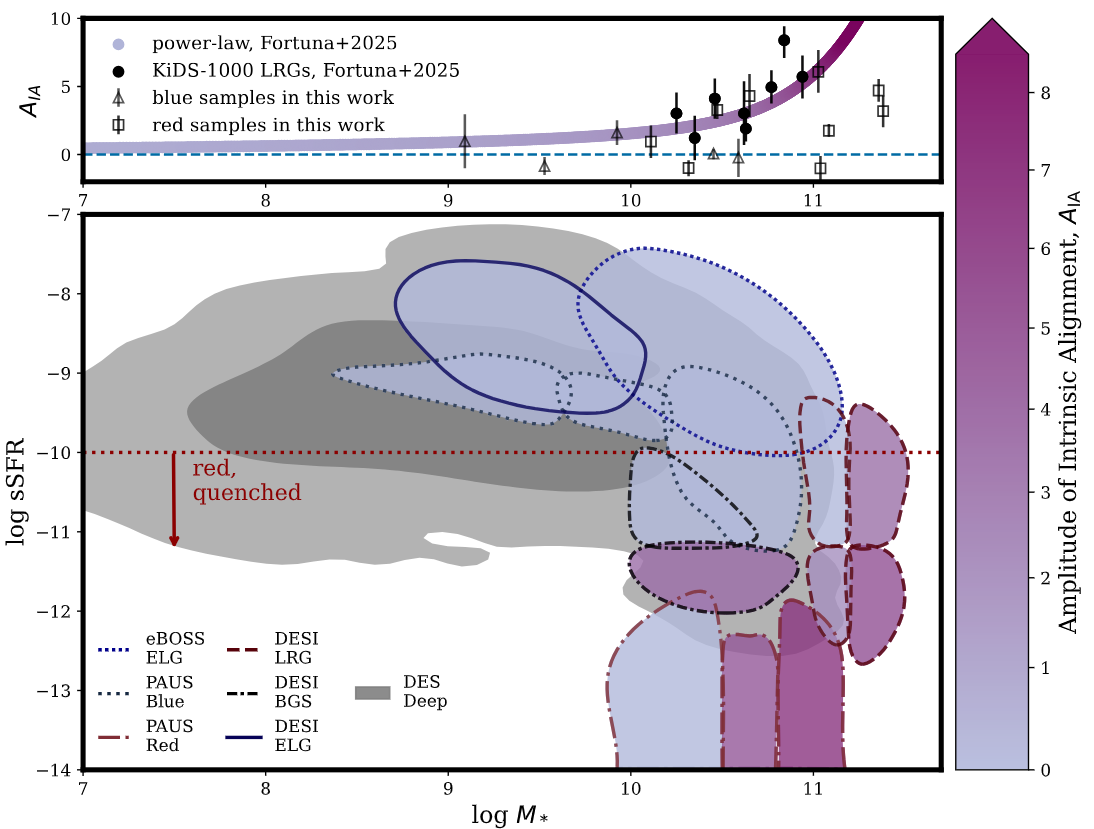
Available data products
- Read the paper: arxiv, journal (TBA)
- Read the previous direct measurements paper using DESI Y1:
Siegel, McCullough, et al. (2025) - To access the DESI \(w_{g+}\) measurements for the sSFR and stellar mass splits in this work: